


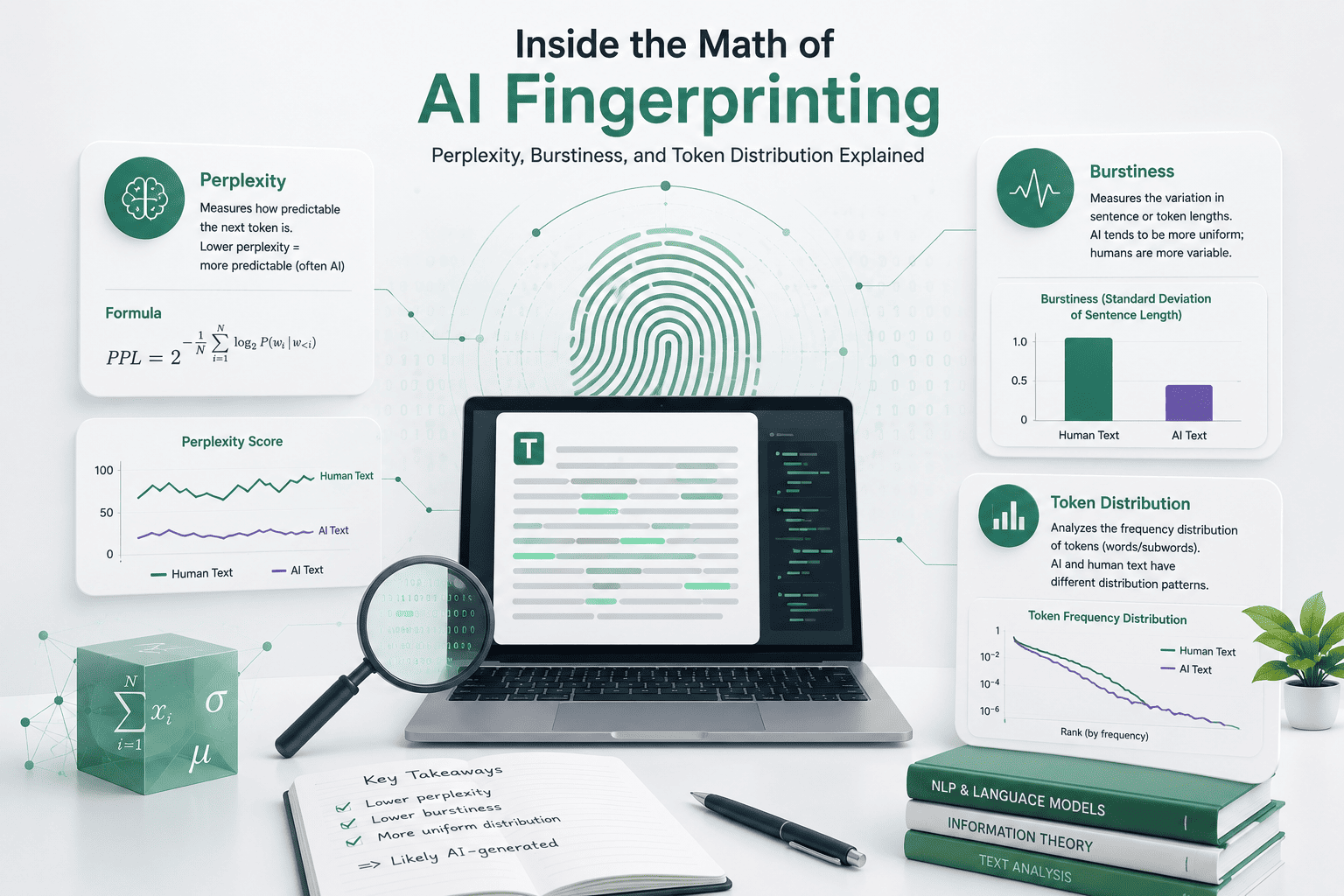
To most people, artificial intelligence text generation feels like magic. You type a prompt into a box, and seconds later, coherent paragraphs appear on your screen. But beneath the polished interface lies pure mathematics: high-dimensional probability matrices calculating the statistical likelihood of word sequences. Understanding how AI fingerprints are calculated requires opening up the mathematical hood of perplexity and burstiness metrics.
1. Understanding Perplexity: Calculating Predictability
At its mathematical core, perplexity measures how well a probability model predicts a sample of text. Low perplexity indicates that the word choices are highly predictable given the preceding context. High perplexity indicates that the word choices are unexpected or creative.
When an LLM generates text, it selects words that maximize cumulative probability. As a consequence, the calculated perplexity of machine-generated paragraphs remains consistently low across the entire document. Human writers, by contrast, introduce unexpected vocabulary choices, regional idioms, and creative metaphors that create natural spikes in perplexity scores.
2. Understanding Burstiness: Measuring Sentence Variance
While perplexity evaluates word choice predictability, burstiness measures the statistical variance of sentence lengths and structures throughout a document. Human thought is non-linear; humans write with high structural variance.
In machine-generated text, burstiness scores remain near zero, indicating uniform sentence length distribution. In human-crafted essays and journalism, burstiness is significantly higher, reflecting dynamic rhythm transitions between short assertions and complex explanatory clauses.
3. Multi-Layered Analysis in Deep Engines
Advanced linguistic platforms combine perplexity scoring and burstiness evaluation with multi-model fingerprinting. Modern engines process incoming document text through three real-time computation stages:
- Tokenization & Vector Embedding: The input text is tokenized and mapped into high-dimensional vector representations.
- Cross-Entropy Evaluation: Neural network layers compare token probability sequences against baseline distributions of GPT-5, Claude, and Gemini models.
- Sentence-Level Confidence Classification: Perplexity and burstiness scores are computed for every sentence, generating a granular confidence heat map for the end user.
4. Summary
AI text detection is not based on guesswork or arbitrary rules. It is grounded in rigorous mathematical evaluation of token probabilities, perplexity distributions, and structural variance. Modern detection engines leverage these mathematical principles to provide transparent, verifiable content analysis at scale.