



If you have spent any time online recently, you have likely encountered the growing debate around artificial intelligence and its ability to mimic human thought. From student essays to marketing copy, AI is everywhere. This has created a massive demand for transparency, leading to the rise of AI detection technology. But for many, these tools feel like a black box. How can a software program look at a string of sentences and decide if a human or a robot wrote them? It is not about magic or guessing. It is about a sophisticated blend of linguistics, statistics, and probability.
The Foundation of Machine Learning in Detection
To understand detection, you first have to understand how AI writes. Models like GPT or Claude are essentially highly advanced autocomplete systems. They do not understand the world. They understand the statistical likelihood of one word following another. Because they are built on math, they leave behind a mathematical fingerprint.
AI detectors are trained to find that fingerprint. Most modern detectors are actually AI models themselves. Developers feed these detectors millions of examples of human writing and millions of examples of AI writing. Over time, the detector learns the subtle differences in how these two groups structure information. It starts to recognize that humans are chaotic, emotional, and unpredictable, while machines are efficient, logical, and repetitive.
The Core Metrics: Perplexity and Burstiness
When you hit the scan button on an AI detection website, the engine immediately looks at two primary factors. These are the gold standard for separating biological writing from synthetic output.
The Concept of Perplexity
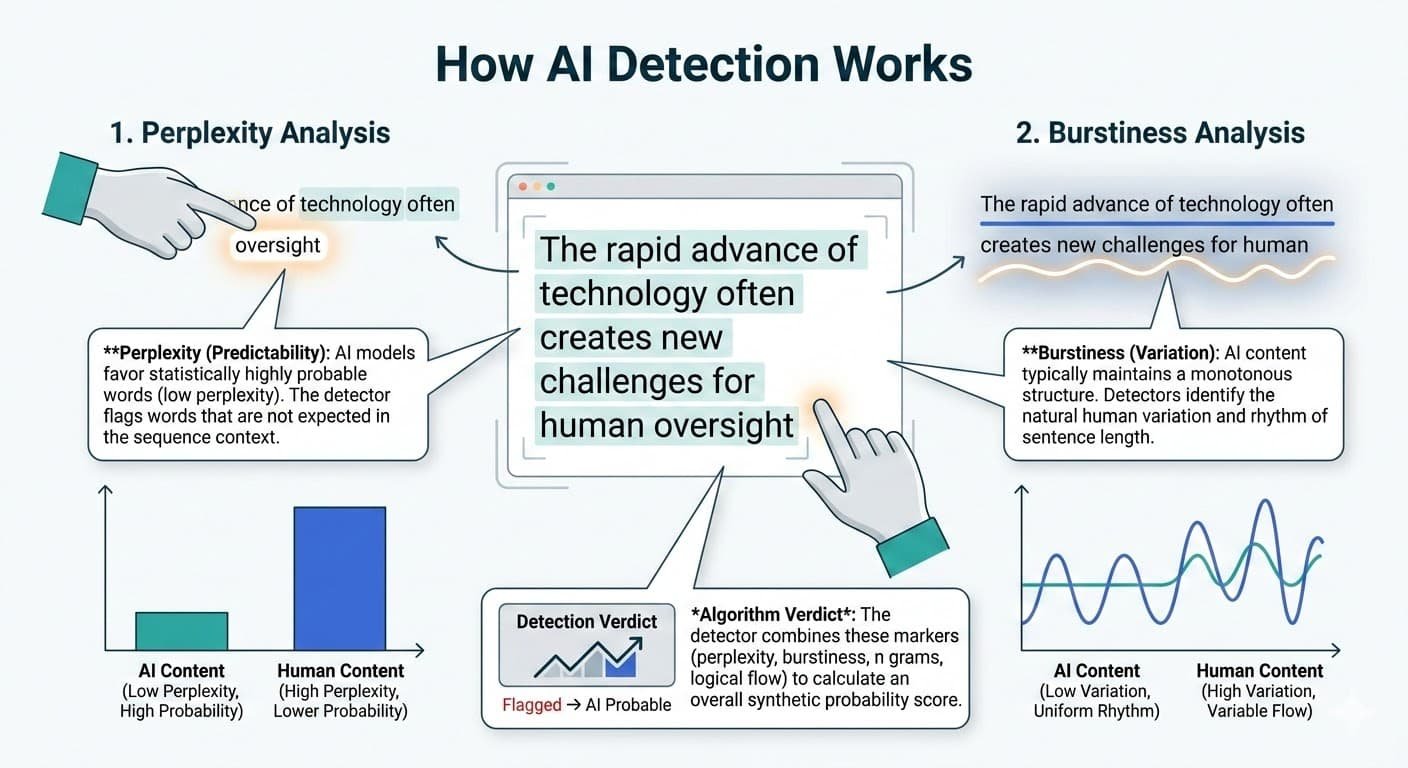
Perplexity is a measurement of randomness. In the world of information theory, if a text has low perplexity, it is very easy to predict. If a text has high perplexity, it is complex and unexpected.
AI models are designed to be helpful and clear. To achieve this, they usually choose the most common or likely word in a sequence. If a sentence starts with "The quick brown fox," a machine is almost certain to follow up with "jumps over the lazy dog." That is a low perplexity choice. A human might decide to write "The quick brown fox decided to take a nap instead." That choice is less predictable.
Detectors calculate the probability of every single word in your document. If the entire text follows a path of high probability, the detector concludes that a machine likely generated it. Humans naturally use rare words, odd metaphors, and slightly "incorrect" but creative phrasing that spikes the perplexity score.
The Role of Burstiness
While perplexity looks at individual words, burstiness looks at the structure of the sentences. Think of it as the rhythm of the writing.
If you look at a paragraph written by an AI, you will notice a very steady, consistent beat. The sentences are often roughly the same length. They use similar grammatical structures. This is low burstiness. It is like a steady drumbeat that never changes.
Human writers do not work that way. We might write a long, rambling sentence that covers three different ideas and uses four commas. Then, we follow it with a short, punchy sentence. This variation creates "bursts" of activity in the text. High burstiness is a very strong signal of human authorship because machines struggle to replicate the natural ebb and flow of human thought processes.
Advanced Linguistic Analysis
Beyond these two metrics, high quality detectors look at deeper layers of the text. They analyze the DNA of the writing style through several different lenses.
N-Gram Analysis
An N-gram is simply a sequence of words. A 2-gram is a pair of words, and a 3-gram is a triplet. Detectors look at the frequency of these word clusters. AI models tend to rely on specific "safe" transitions. If a detector sees a high frequency of phrases like "it is important to note," "furthermore," or "in conclusion," it starts to build a case for AI. Humans use a much wider and more eccentric variety of transitions and connectors.
Syntax and Grammar Patterns
AI is almost too perfect when it comes to grammar. It rarely makes a typo. It almost never misses a comma. More importantly, it follows rigid rules of syntax. It loves the active voice or specific types of balanced sentences. Detectors scan for this "perfection." ironically, a few minor human errors or an unconventional sentence structure can actually be the best proof that a person wrote the piece.
The Latest Data: How Modern Detectors Stay Ahead
The field of AI detection is a constant arms race. As generative models get better at mimicking humans, detectors must become more sensitive.
Recent data suggests that the most effective detectors now use "transformer" based architectures. This means the detector does not just look at one sentence at a time. It looks at the entire document at once to see if the global context makes sense. AI sometimes "hallucinates" or contradicts itself between the first paragraph and the last. Modern detectors catch these logical gaps.
Furthermore, some developers are now using "Classifier" models. These are specifically tuned to identify the specific weights and biases of known engines like GPT-4. By knowing how the "source" thinks, the detector can reverse engineer the text to see if it matches the output of that specific engine.
The Limitations and the Ethics of Detection
It is important to be honest about the fact that no detector is one hundred percent accurate. There is always a margin of error.
False Positives
Sometimes, a very talented human writer who has a very formal or academic style might be flagged as AI. This is because academic writing often has low perplexity and low burstiness. It is structured, logical, and uses standard professional terminology. This is why we always recommend using detection as a tool for starting a conversation rather than a final verdict.
The Impact of Editing
If a human takes an AI generated draft and heavily edits it, adding their own stories, jokes, and unique sentence structures, the detection score will change. This is actually a good thing. It shows that the "human" has taken control of the creative process. The detector is doing its job by noticing that the robotic fingerprints have been smudged by human intervention.
Why This Matters for the Future
As we move forward, the ability to verify the origin of content will be crucial for trust. Whether it is a news article, a legal brief, or a school assignment, knowing that a human is standing behind those words adds a layer of accountability.
AI detection is not about "catching" people or being a digital police officer. It is about preserving the value of human creativity. It ensures that when we read something that moves us or teaches us something new, we know there was a real person on the other side of that screen.
The technology will continue to evolve. We will see more focus on "watermarking," where AI companies embed invisible signals in their text. We will see detectors that can analyze voice and video just as easily as text. But the core principle will remain the same. We are looking for the "ghost in the machine" or, more accurately, the lack of one.
Conclusion
Understanding how AI detection works takes the mystery out of the process. It is a logical, data driven approach to analyzing the patterns of language. By looking at perplexity, burstiness, and linguistic probability, these tools provide a vital service in a world where the line between human and machine is becoming increasingly blurred.
If you are using an AI detection website, remember that you are looking at a snapshot of probability. It is a powerful lens that helps us navigate the new digital landscape with more clarity and confidence. The more we understand the math behind the words, the better we can appreciate the unique, unpredictable, and wonderful nature of human communication.